Private charter vs shared trip: what's the difference for boat operators?
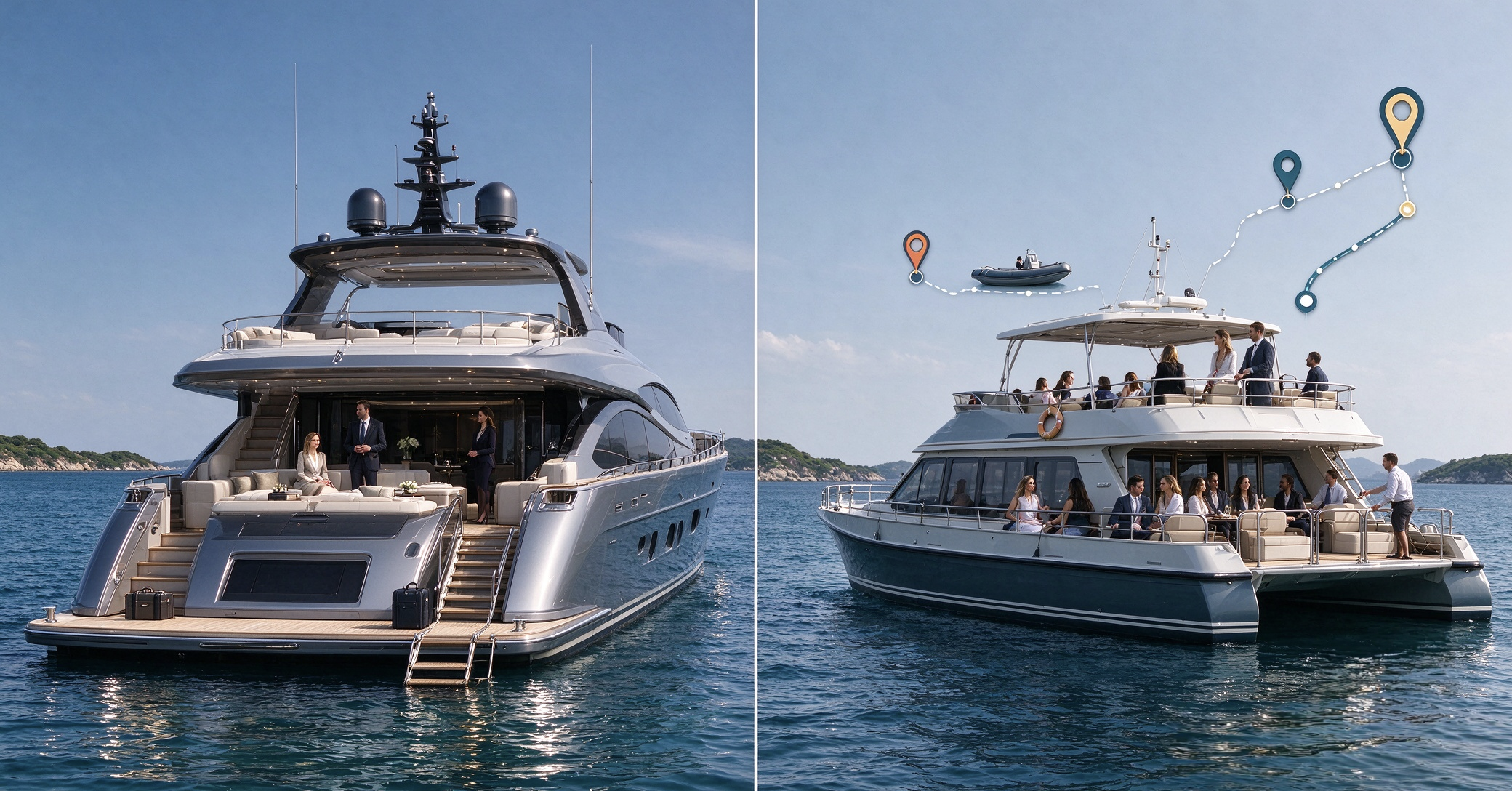
The difference between a private charter and a shared trip is what you sell. A private charter sells the whole boat to one group at one price. A shared trip sells individual seats at a price per person, and the boat sails with guests from several bookings. That changes pricing, capacity, scheduling, cancellations and how you fill the boat.
Private charter vs shared trip at a glance
| Private charter | Shared trip | |
|---|---|---|
| What is sold | The whole boat for a set period | One seat on a scheduled departure |
| Price basis | One price per boat, per trip | One price per person |
| Who is on board | One group, no strangers | Guests from several bookings |
| Capacity | The licensed guest limit; you can sail below it | The same limit, but the seat is the unit on sale |
| Departure time | Chosen by the guest | Fixed by the operator |
| Revenue risk | A slow day costs you the whole trip | A slow day costs you the unsold seats |
| Cancellations | One decision on one large booking | Per-seat refunds, plus a minimum-guest decision |
| Typical buyer | Families, groups, companies, occasions | Solo travellers, couples, price-led buyers |
The rest of this guide takes each row and turns it into something you can set up in your own operation.
How each model is priced
A private charter is quoted per boat. The price covers the boat, crew and fuel for a block of time, so the guest's cost per head falls as the group grows. In Dubai, one published rate is AED 1,500 for a four-hour fishing charter on a 36 ft boat licensed for up to 10 guests, with gear, bait, fuel and soft drinks included. At six guests that is AED 250 each; at ten guests it is AED 150 each. The boat earns the same either way. For context, a survey of 160 boats listed on charter in Dubai in September 2026 put the median hourly rate at AED 1,850, with 5% VAT added on top of the quoted rate.
A shared trip is quoted per person. Each guest buys a place on a departure you have already scheduled, and the price usually includes the same gear and fuel. A Hua Hin operator publishes 2,000 THB per person for a shared fishing place, including children, with at most 12 guests per departure. A full boat is 24,000 THB; four guests is 8,000 THB.
The number that connects the two models is the full-boat per-guest rate:
Full-boat per-guest rate = private charter price ÷ licensed guest capacity
For the Dubai boat above, that is AED 1,500 ÷ 10 = AED 150. It is what a group of ten would pay per head for the same boat, which makes it the number to beat when you price a seat. A couple booking the boat alone pays AED 750 each, which is why a shared seat can sit above the full-boat rate and still look cheap to a small group.
Where a shared trip actually earns more. Crew, fuel and departure costs are committed whether the seats sell or not, and every guest adds cost on top: bait, tackle, food, insurance per head, cleaning. So the break-even point is not "sell enough seats to match the charter price"; it is "sell enough seats to cover the charter price plus the extra cost of those guests":
Break-even seats = private charter price ÷ (seat price − per-guest cost)
At a seat price equal to the full-boat per-guest rate, you need every seat sold just to match one charter. One booking-tool vendor illustrates the same arithmetic with a 6-seat boat at $250 a seat against a $1,500 charter: 100% occupancy to draw level, and 75% occupancy produces $1,125. That is the number to watch before you decide a shared trip is the more profitable format.
Capacity, minimum guests and what happens when a departure does not fill
Capacity is a licensed limit, not a sales target. In Dubai, every guest on board counts towards the boat's guest limit whether they fish or not, and guests must carry a passport or Emirates ID under Coast Guard rules. A boat licensed for 10 guests can sail with six, but it cannot take eleven, however many seats you would like to sell.
On a shared trip, the number of seats you put on sale is a separate decision from capacity. A 12-guest boat can sell 8 seats and keep the deck comfortable, or sell 12 and fill it. Whichever you choose, the limit has to live in the schedule, because that is where the seats are counted.
Minimum guests is the shared-trip equivalent of a minimum charter. One Hua Hin operator runs a shared departure with at least four confirmed guests and never fewer, checks the group 24 hours before departure, and if the count is short offers another date or cancels without charge and refunds anything paid. That minimum is published before anyone pays, which is what makes it defensible.
To set your own minimum, start from the cost of running the departure:
Minimum seats = fixed cost per departure ÷ (seat price − per-guest cost)
Round up, then compare the result with the occupancy you actually achieve. Vendor estimates put shared-trip occupancy at 60–80% across a season, with 10–15% no-shows even when deposits are taken, so a minimum that only works at 95% occupancy is a minimum you will miss every week.
Two rules make the minimum work in practice:
- Publish the minimum and the check time in the listing and the terms, not in a WhatsApp reply on the day.
- Decide once, at a fixed hour. A departure that is still short at the cut-off either runs at a loss or moves; deciding at the dock turns a policy into a negotiation.
Scheduling: fixed departures versus start times the guest chooses
A shared trip runs on a timetable you own. The Hua Hin example runs 08:30–12:30 in the morning and 18:00–22:00 at night, closes online requests 24 hours before departure, and shows the places left after confirmed bookings. Every departure is an inventory item: seats come off the count the moment a booking is confirmed, and the cut-off is what stops a departure from being oversold at the last minute.
A private charter runs on a start time the guest chooses, inside your operating window. The boat is blocked for the package length plus turnaround, and a minimum charter length applies — two hours in Dubai is common. Two charters back to back on the same boat need a cleaning and refuelling gap between them, or the second one leaves late.
The two models meet in one place: the boat's day. A private block and a set of seats compete for the same hours, so the schedule has to hold both as capacity on the same boat. The classic failure is a charter sold into a slot that already has seats on sale, or seats sold for a departure that a charter has taken over. One schedule with capacity counted per departure prevents both, which is what boat scheduling software is for.
Cancellations, weather and refunds
The two models carry different exposure, so they need different rules.
A private charter is one large booking. A published Dubai policy runs on notice: 72 hours or more before departure, the deposit is refunded in full; 24 to 72 hours, the deposit is held as credit against a date within 90 days; under 24 hours, the full charter fee is retained; a guest who does not arrive within 60 minutes counts as a no-show and the full fee is retained. One decision, one amount.
A shared trip is many small bookings. Each seat carries its own refund, and the operator can also cancel the departure for low numbers. A typical shared policy refunds seats cancelled at least 24 hours ahead, keeps the money inside 24 hours unless the seat is refilled, and refunds everything if the trip cannot run because the group fell below the minimum. The per-seat amounts are small, but there are many of them, and each one has to be matched to the right booking.
Weather is the exception that overrides both. Who makes the call differs by market: in Dubai the Coast Guard has the final say, and an operator policy commits to a free reschedule or a full refund when they cancel; in Thailand the captain decides whether it is safe to leave the pier, and the operator then offers another date or a refund. Whichever applies, publish who decides, by when, and what the guest gets.
Two operational habits keep cancellations from turning into disputes:
- Keep the rules on the product, not the company. A shared seat and a private charter can have different notice periods, and the booking should carry the rule that applied when it was made.
- Record the refund against the order. At the end of the day, the revenue figure has to net out what was refunded, or the numbers stop matching the bank.
Running both on one boat
Most operators end up selling both, and for good reasons. Shared seats fill the days a charter would otherwise leave empty, reach solo travellers and couples who will never book a whole boat, and give a group a cheap way to try the boat before they book it privately. Private charters protect the margin on weekends and high season.
The risks are just as real:
- Price anchoring. A cheap seat price becomes the reference point a guest uses when you quote a charter for the same boat.
- Channel conflict. An agent selling shared seats and a direct salesperson quoting the charter can promise the same boat to two different buyers.
- Overselling. A private block and a set of seats on the same departure look like separate products until someone checks the boat's day.
- Crew cost per departure. A shared departure with three guests still needs a captain and a deckhand; the trip has to pay for them.
Five things to set up before you run both:
- One schedule that shows every departure and every charter on the same boat, with capacity counted as seats are sold.
- Separate packages: a shared seat product priced per person, and a charter package priced per boat.
- Separate cancellation terms, attached to the product rather than to the customer.
- One order per booking, with payments and refunds recorded on it.
- A rule for the good problem: when one group buys every seat, convert the departure into a private charter instead of selling the last seat to a stranger.
Bokvo keeps private charters and shared trips on the same schedule, counts capacity as seats are sold, and records payments and refunds on the same order — the three places where the two models otherwise drift apart. You can see the schedule side on boat scheduling software, the order side on charter booking software, and the money side on charter payment tracking.
FAQ
What is the difference between a private charter and a shared trip?
A private charter is the whole boat for one group at one price. A shared trip is a single seat at a per-person price, on a departure that carries guests from several bookings.
Is a shared trip the same as a join-in trip?
Yes. Join-in trip, open trip and seat-based booking describe the same model: the guest buys a place on a scheduled departure rather than the boat.
Can I sell private charters and shared trips on the same boat?
Yes, on different departures. The boat is either blocked for one group or sold seat by seat for a scheduled departure, and the schedule has to count both as capacity on the same boat.
How do I set the price of a shared seat?
Start with the full-boat per-guest rate — the charter price divided by licensed capacity — add the per-guest cost of the seat, then compare with what the market pays. A seat priced at the full-boat rate needs every seat sold to match one charter.
What happens if a shared trip does not reach its minimum number of guests?
The operator either runs the departure at a loss, moves the guests to another date, or cancels and refunds. The decision time and the outcome belong in the terms before the guest pays.
Published 13 November 2026. Last updated 13 November 2026. Prices and policies cited were checked on the dates shown below.
Sources
- Yachts Dubai, Group Fishing Charter in Dubai — 17 October 2026; prices checked 13 November 2026.
- Gold's Yacht, Yacht Rental Prices in Dubai — measured 29 September 2026; checked 13 November 2026.
- Elite Rentals Dubai, Refund & Cancellation Policy — updated 5 August 2026; checked 13 November 2026.
- Hua Hin Fishing, Booking terms — 24 October 2026; checked 13 November 2026.
- Reservety, Charter Private vs Split Calculator — vendor estimates; checked 13 November 2026.